
The Power Plants Inside Your Heart
Your heart never takes a day off. But where does it get the energy to keep beating? The answer is hidden inside billions of tiny cells.
Explore: A Power Plant You Can See
Think about a power plant. Its job is to convert energy from a source such as moving water, wind, or fuel into electricity that people can use.
Now imagine an energy-converting system so small that you need a microscope to see it. What if you had thousands of these little power plants inside just one heart muscle cell?

A Power Plant
Converts energy from one form into electricity that can power homes, schools, and cities.
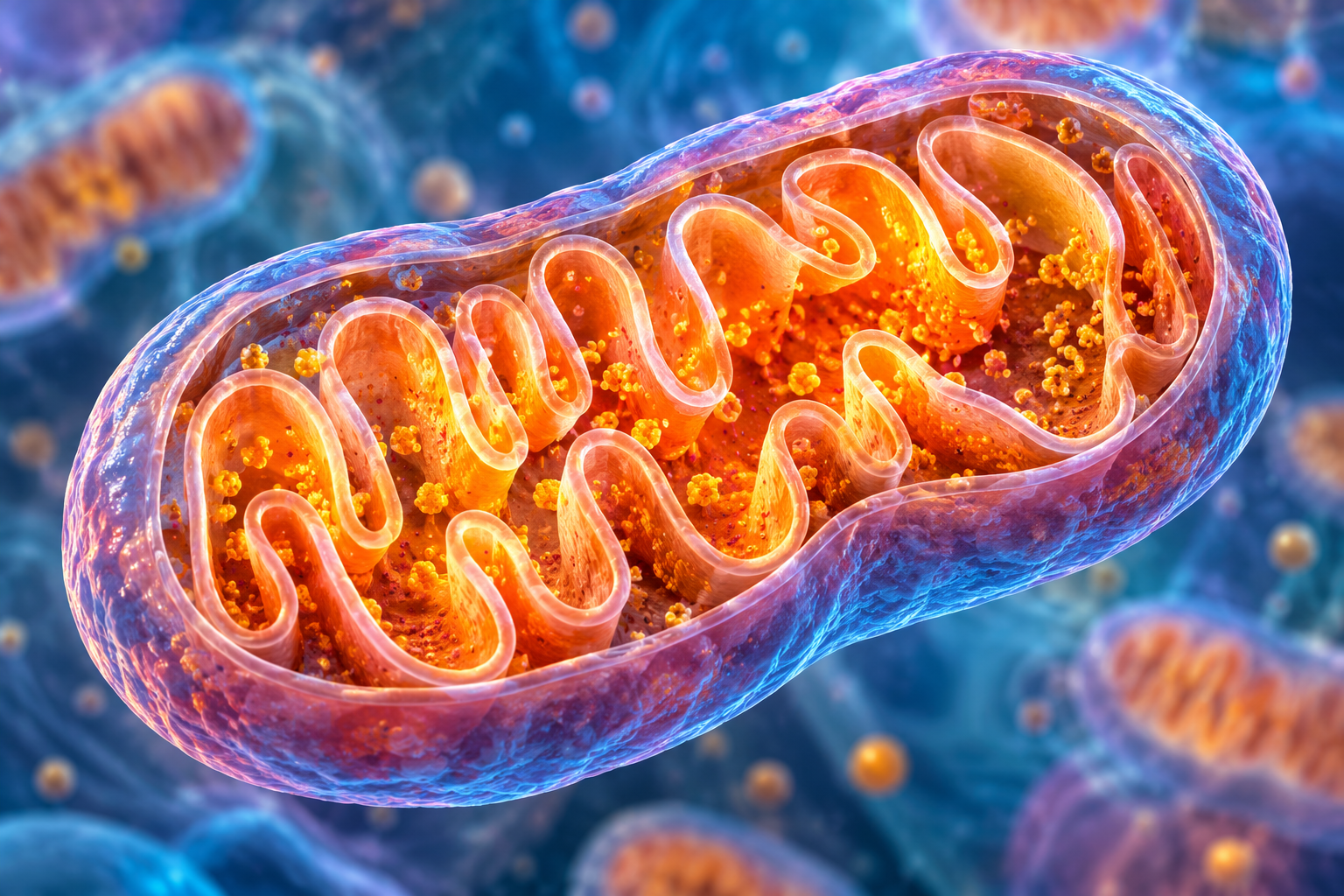
A Mitochondrion
Uses energy from nutrients to help produce ATP, a molecule that supplies usable energy for cell activities.
Different kinds of power. One amazing principle: both systems convert energy into a form that can do useful work!
Just like a power plant converts energy into electricity that powers a city, mitochondria convert energy from nutrients into ATP that powers the activities of your cells. Different kinds of energy, but the same amazing principle: **energy conversion!**
Discover: The Numbers Are Astonishing
In 2016, the U.S. Energy Information Administration reported an estimate of 62,500 power plants worldwide for 2015.
The World Resources Institute's global database originally documented about 30,000 power plants. Its later dataset grew to roughly 35,000. These counts use different methods and coverage, so neither is an exact count of every power plant operating today.
Now let's compare those enormous facilities with the microscopic mitochondria inside a human heart.
Estimated power plants worldwide in 2015, according to the EIA
Heart muscle cells in a human heart
Mitochondria that may be found in a single heart muscle cell
Heart muscle cells are called cardiomyocytes. They contract and relax to help pump blood throughout your body.
Because this work requires so much energy, heart muscle cells are packed with mitochondria. Studies describe thousands in individual cells, although the number varies with cell type, age, and how mitochondria are counted.
In fact, mitochondria can occupy roughly 30% of the volume of an adult heart muscle cell. Imagine dedicating almost a third of a room to equipment that helps supply its energy!
How Many Tiny Power Plants?
Using a simplified example of a human heart with 3 billion muscle cells and 6,000 mitochondria in each cell, how many mitochondria would that be altogether?
Tap to reveal the answer!
C) 18 trillion!
= 18,000,000,000,000
That's 18 trillion microscopic energy converters in our example!
Important science note: This is an illustrative multiplication exercise, not a directly measured count. Researchers report different estimates for heart muscle cell numbers and mitochondria per cell. We cannot use this calculation to claim that every person, or every 10-year-old child, has exactly 18 trillion heart mitochondria.
Connect: What About a 10-Year-Old's Heart?
Imagine a 10-year-old riding in the car, looking out the window at a giant power plant.
That child has a heart filled with muscle cells that need energy every moment of every day. Inside those cells are mitochondria helping produce ATP so the heart can keep working.
Scientists have studied how the number and size of heart muscle cells change as children grow. But there isn't one scientifically established mitochondrial total that applies to every 10-year-old.
Here's what we can say: the energy system inside a child's heart is extraordinarily complex, even though most of it is completely invisible to us.
🚗 Take the Connection With You!
Next time you pass a power plant, share this amazing connection with someone riding along:
"That giant building converts energy into electricity. But did you know your heart has billions of cells, and many of those cells contain thousands of tiny energy converters called mitochondria?"
Then ask: "What other things around us might help explain something happening inside our bodies?"
One More Amazing Connection
A power plant is only useful when its energy reaches the places that need it.
Your cells also depend on coordinated systems. Mitochondria help produce ATP, while other cellular structures use that energy to perform their specialized jobs.
That's the idea behind The City Inside You: using familiar parts of a city to discover the extraordinary systems working inside living cells.
Sources & Further Discovery
- U.S. Energy Information Administration. "The world's nine largest operating power plants are hydroelectric facilities." October 18, 2016. Read the EIA report .
- World Resources Institute. "A Global Database of Power Plants." April 5, 2018. Explore the database .
- World Resources Institute. Global Power Plant Database, later dataset releases. View dataset documentation .
- Cellular Communications in the Heart. Review describing estimates of 2–3 billion cardiac muscle cells. Read the research .
- Mitochondrial Calcium and the Regulation of Metabolism in the Heart. Review discussing mitochondrial abundance in ventricular heart cells. Read the research .
- Mitochondrial Dynamics and Inter-Mitochondrial Communication in the Heart. Review describing approximately 6,000 mitochondria in adult mammalian cardiomyocytes. Read the research .